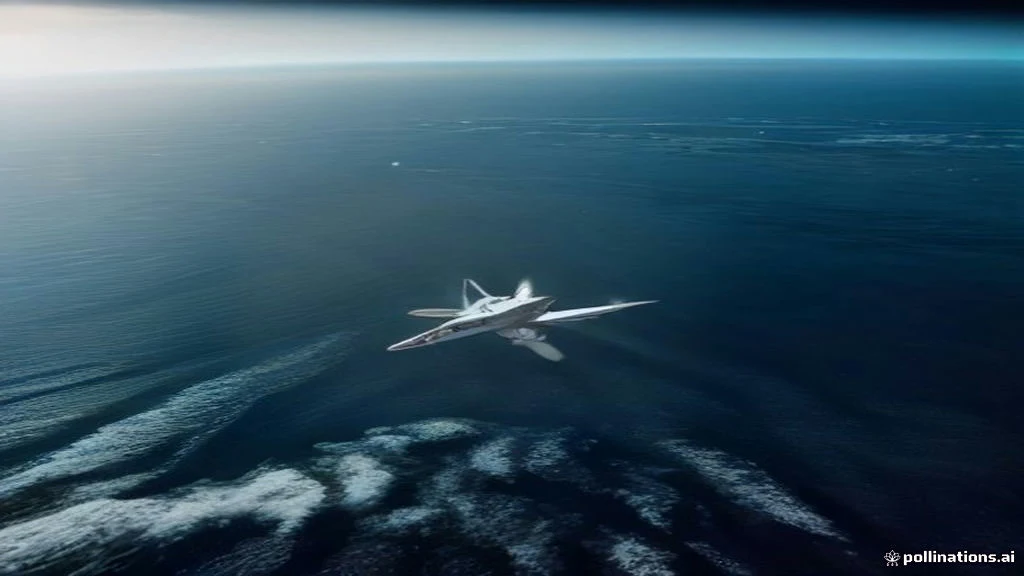
The UK’s ambition to lead the global telecommunications race is no longer confined to the terrestrial fibre-optic grid. As the government’s Science and Technology Framework pushes toward the 6G horizon, the focus has shifted skyward. Specifically, the integration of High-Altitude Platform Stations (HAPS)—autonomous, solar-powered aircraft lingering in the stratosphere—serves as the cornerstone of a new, sovereign communication layer. However, unlocking the terabit-per-second potential of the Sub-Terahertz (Sub-THz) spectrum (100 GHz–300 GHz) requires overcoming a formidable adversary: atmospheric scintillation.
The Physics of the Stratospheric Challenge
To understand the difficulty of Sub-THz propagation, one must first look at the unique environmental profile of the United Kingdom. Unlike the stable, arid climates often used for satellite testing, the UK’s maritime environment introduces rapid fluctuations in humidity, pressure, and temperature. These fluctuations create turbulent cells in the troposphere, leading to what engineers call atmospheric scintillation.
In the context of 6G, scintillation acts as a dynamic interference pattern. As Sub-THz waves pass through these turbulent pockets, the signal experiences rapid, unpredictable fluctuations in both amplitude and phase. According to the Ofcom Spectrum Engineering Research Division, these signals suffer an average degradation of 15-25 dB in the UK’s climate. Without sophisticated waveform design, the high-frequency links required for 6G simply collapse under the weight of these environmental variables.
The Role of HAPS in Future Connectivity
High-Altitude Platform Stations act as the 'missing link' in the UK’s infrastructure. By operating at approximately 20 kilometres, these platforms bypass the most dense layers of the weather-prone lower atmosphere while maintaining a proximity to the ground that is vastly superior to traditional Low Earth Orbit (LEO) satellites.
| Feature | Terrestrial 5G | HAPS (6G) | LEO Satellite |
|---|---|---|---|
| Latency | < 1ms | 2-5ms | 20-40ms |
| Coverage | Limited | Regional/National | Global |
| Cost/Deployment | High (Cabling) | Medium (Flight) | Very High (Launch) |
| Scintillation Impact | Low | Moderate | High |
[AD_CENTER]
Designing Robust Waveforms for Dynamic Environments
Dr. Elena Rossi, Lead Researcher at the 6G Innovation Centre (6GIC) at the University of Surrey, argues that static modulation is a relic of the past. To survive the UK’s volatile atmosphere, the waveform must be 'intelligent.'
Modern research into Sub-THz waveform design is shifting toward adaptive, AI-driven physical layer architectures. Instead of fixed pulse-shaping filters, engineers are developing waveforms that 'learn' the turbulence patterns of the local stratosphere. By utilizing real-time feedback loops, the HAPS can adjust its modulation and coding schemes (MCS) in milliseconds to compensate for phase shifts before they manifest as data loss.
The Integration of Machine Learning at the Physical Layer
The transition from hardware-defined to software-defined waveforms is the key to this resilience. By embedding machine learning models directly into the baseband processing of the HAPS, the system can predict the onset of scintillation. This 'pre-compensation' involves shifting the carrier phase or adjusting the symbol duration to maintain signal integrity despite the shifting refractive index of the atmosphere.
Socio-Economic Impact and the Levelling Up Agenda
Beyond the technical hurdles, the deployment of HAPS in the UK is a strategic economic imperative. The UK Space Agency and Frontier Economics estimate that HAPS-based connectivity could contribute £2.4 billion to the UK economy by 2030.
This is not merely about faster mobile downloads in London; it is about bridging the 'digital divide' in the Scottish Highlands, the Orkney Islands, and the burgeoning offshore energy sector. By providing a high-capacity backhaul through the air, the UK can bypass the prohibitively expensive task of laying subsea cables to remote wind farms or isolated rural communities. This infrastructure allows the UK to position itself as a high-tech exporter of HAPS hardware and waveform-processing software, turning the stratosphere into a national asset.
[AD_CENTER]
Case Study: The North Sea Flight Trials
Looking toward the 2026-2028 window, the UK is moving from the laboratory to the North Sea. These trials represent the first large-scale test of Sub-THz waveforms in real-world, high-turbulence maritime conditions.
In these trials, HAPS platforms will be equipped with phased-array antennas capable of beamforming at 200 GHz. The goal is to maintain a stable, 10 Gbps link to maritime vessels, simulating the backhaul requirements of future 6G small cells. The data collected from these flights will be used to calibrate the predictive models that will define the global standards for 6G non-terrestrial networks.
Future Outlook: Setting the Global Benchmark
As the UK government continues its £100 million investment into the 6GIC, the focus will inevitably turn to international standardization. By 2030, the ITU-R will be finalizing the protocols for Sub-THz non-terrestrial communication. The UK’s early focus on mitigating scintillation through waveform design provides a significant "first-mover" advantage.
By mastering the interaction between the stratosphere and high-frequency waves, the UK is not just building a better network—it is creating a blueprint for global connectivity. The ability to predict, adapt, and overcome the atmospheric turbulence of the North Atlantic will define the next generation of telecommunications policy, ensuring that geography no longer dictates the quality of digital life.
[AD_CENTER]
Conclusion: The Path Forward
The challenge of Sub-THz 6G is profound, yet the path to resolution is clear. Through the integration of AI-driven waveform design and the strategic deployment of HAPS, the UK is addressing the physical limitations of the stratosphere while simultaneously driving economic growth. As we move closer to the 2030 commercialization date, the lessons learned from our unique maritime climate will likely serve as the global standard for non-terrestrial network design. The future of the UK’s digital economy is not just in the ground beneath us—it is in the sky above.